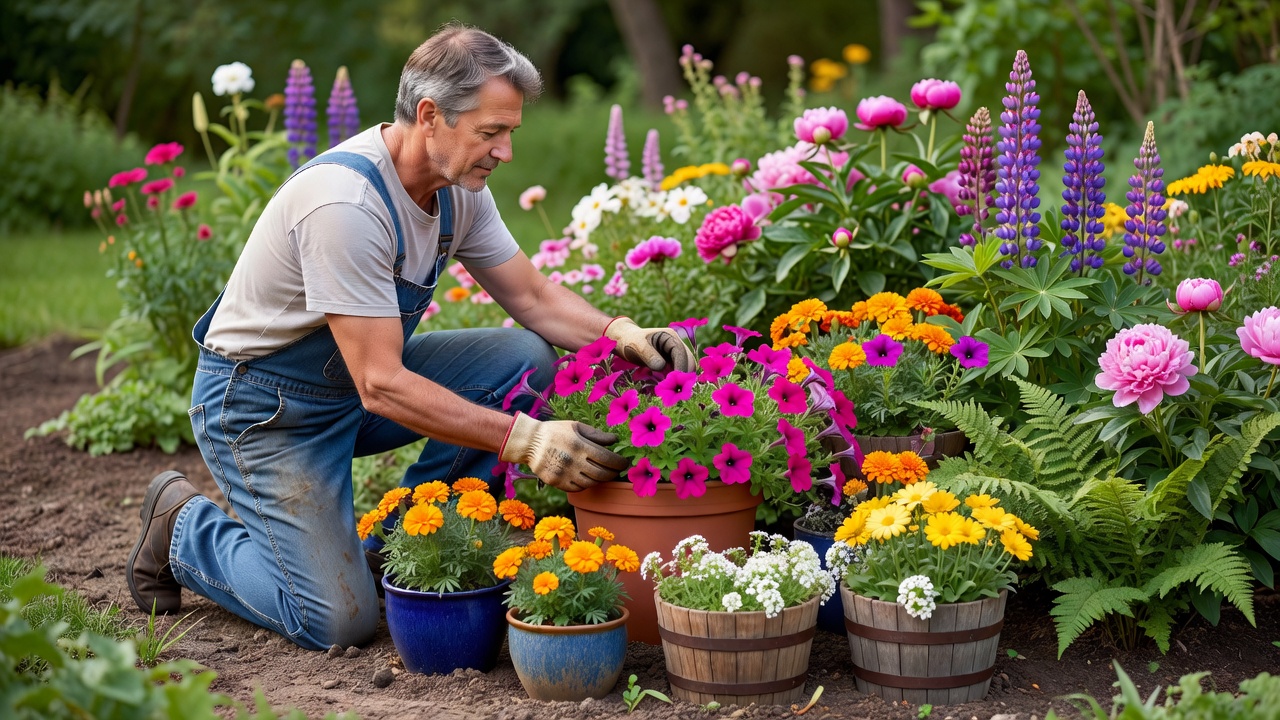
Read the corner before choosing colour
A party-ready border begins with growing conditions, not a shopping basket. Watch how sunlight travels across your chosen corner, check whether rain drains away and notice whether nearby trees compete for moisture. A sheltered courtyard can behave very differently from an exposed terrace, even when both look sunny at lunchtime. Keep a short note of what you observe before buying anything.
Next, look from the seat where people will actually gather. Your planting needs to make sense from that viewpoint, not only from directly above a nursery tray. Taller stems can form a backdrop, while lower foliage softens the edge without spilling over the walking route. Check the eventual height and spread on plant labels; a small pot is not a promise of a small mature plant.
Choose a lead colour and repeat it
For a warm retro mood, start with apricot, burgundy and cream. Apricot brings the cheerful note, burgundy gives it depth, and cream stops the whole scene becoming too dense. You do not need equal quantities. Let the lead colour appear in several places, then use the supporting shades more sparingly. Repeat one tone in a cushion or tablecloth rather than adding another unrelated colour.
Calendula officinalis can offer orange and apricot tones, depending on the cultivar. Cosmos bipinnatus brings airy pinks and whites, while selected Dahlia cultivars offer richer reds and warm peach shades. These are possibilities, not a universal planting recipe. Calendula often flowers in cooler conditions than heat-loving bedding, and dahlias may need lifting or other winter protection depending on your climate. Check local guidance and variety-specific requirements.
A compact colour rehearsal
Set an apricot flower beside dark foliage and a cream fabric sample. View the combination in sun, shade and from your main seat before repeating it across the corner.
Group plants by care, not just appearance
Two plants can look wonderful together and still be awkward neighbours. A plant that likes drying between waterings should not share a confined container with one that needs consistently moist compost. Use separate pots grouped together when their needs differ. This gives you visual unity while letting each plant receive appropriate water, feeding and winter care.
Containers need drainage holes and a suitable growing medium. Avoid leaving roots sitting in collected water, and remember that small pots dry out more quickly than large ones. Put the heaviest containers in position before filling them, using safe lifting help where necessary. On a balcony or raised deck, verify structural loading and building rules rather than assuming that a cluster of wet pots is harmless.
Let foliage do some of the decorating
Flowers come and go; leaves hold the arrangement together. A dark-leaved Heuchera cultivar can echo a burgundy palette, although light tolerance varies between cultivars. Green herbs in separate, accessible pots can make the scene feel generous and useful. Keep edible plants clearly identified, avoid pesticide contamination and never treat an ornamental flower as edible without reliable identification and food-safety guidance.
For pollinator value, investigate open-centred flowers with accessible pollen and nectar rather than choosing by colour alone. The Royal Horticultural Society’s Plants for Pollinators resources are a useful starting point in a UK context; local extension services or native-plant organisations can provide more regionally appropriate advice. A fashionable flower is not automatically a useful food source for local insects.
Keep the scene alive beyond the gathering
Build around what is already healthy in your garden. Add seasonal colour in movable containers instead of replacing established plants for one evening. Remove faded flowers where appropriate, check moisture before guests arrive and water at the root zone rather than splashing the table or paving. Support tall stems before they lean into seating, using visible, secure supports that do not create sharp hazards.
Leave a little room for the border to breathe. Planting densely for an instant photograph can lead to poor airflow and extra maintenance later. Take a picture from your seating position, note which colours carried best and adjust gradually through the season. A successful garden corner should still be enjoyable on an ordinary morning, when the glasses are washed and the last lantern has gone indoors.